
Fluid-applied Resources

Published by Eileen Ybarra on February 2, 2026
One of the most common and costly questions commercial building owners face is: Do I need a roof repair, a restoration, or a full roof replacement? The wrong decision can lead to unnecessary spending, premature failure, or ongoing leaks. While the right decision can extend roof life by years or even decades.
At White Hat Industrial, we help building owners make informed, data-driven roofing decisions based on condition, risk, and long-term asset performance (not sales pressure).
Below is a clear framework to help you understand which option makes the most sense for your commercial roof.
Understanding the Difference: Repair vs. Restoration vs. Replacement
There are distinct differences between repair, restoration, and replacement. Below you can learn more about each, how they’re different, and get a better gauge of when each is the better option.
Commercial Roof Repair: Fixing Isolated Issues & Concerns
Roof repair is for addressing specific localized problems without altering the entire existing roofing system.
This may be appropriate when:
- Leaks are isolated and infrequent
- Damage is limited to flashing, seams, and penetrations
- The roof membrane is generally sound
- The roof is relatively young in its service life
Common types of roofing repairs include flashing replacement, seam repairs, fastener tightening or replacement, and small membrane patches. But there are still limitations. For example, repairs cannot address system-wide aging or underlying deterioration. Additionally, over time, repeated repairs can often be more expensive than other mitigation options.
Commercial Roof Restoration: Extending Roof Life
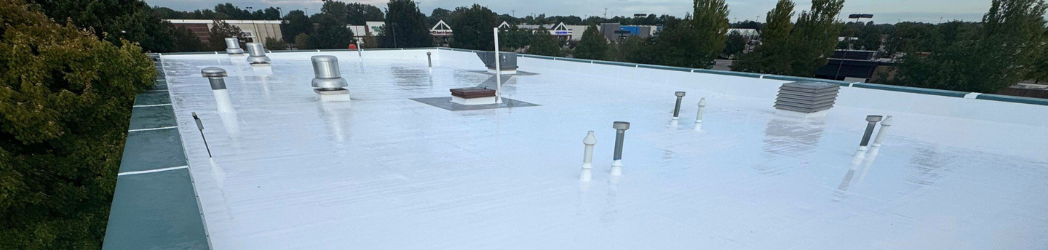
Roof restoration improves and reinforces existing roofing systems with fluid-applied technology, rather than tearing off and replacing.
Restoration is often the best option when:
- The roof is still structurally intact
- The membrane shows aging but is not experiencing extreme saturation
- Leaks are becoming more frequent, and patching isn’t working
- You want to extend the lifespan of the existing roof for another 15-20 years
Fluid-applied roofing systems work well here because they create a seamless, fully adhered membrane across the roof surface. In fact, they eliminate roof leaks with waterproofing features, accommodate thermal expansion and contraction, reinforce the performance of aging roof systems, improve reflectivity and on-site energy efficiency, and extend the overall lifespan of the roof for 15-20 years.
Full Roof Replacement: When It’s Necessary
A full roof replacement entails removing the existing roofing system completely and installing a new one from the deck up.
Replacement is typically necessary when:
- The roof has widespread structural or saturation damage
- The membrane has reached the end of its service life (Repairs and restoration are no longer a viable option due to reactivity)
- Building use or code requirements have changed
While replacement may be unavoidable in some cases, it is also the most expensive and disruptive option. For this reason, objective observation and assessment are critical.
How to Decide: Key Factors We Evaluate at White Hat Industrial
When determining whether repair, restoration, or replacement is appropriate, our team of industry experts considers:
1. Roof Age vs. Roof Condition
Age alone does not always dictate replacement. We often see older roofs that perform well, and newer roofs that fail prematurely because of poor installation or maintenance.
2. Moisture Intrusion & Saturation
Moisture surveys help determine whether insulation or decking is compromised. Restoration is typically viable only when saturation is limited.
3. Leak Frequency & Location
Recurring leaks in different areas may indicate system-wide issues rather than isolated failures.
4. Lifecycle Cost, Not Just Initial Cost
The least expensive option upfront is not always the most cost-effective over time. Restoration often delivers the strongest return on investment.
5. Risk Tolerance & Long-term Planning
Your capital plan, operational risk tolerance, and long-term ownership goals matter when selecting the right solution.
Why Work with Our Team at White Hat Industrial
At White Hat Industrial, we are not just a roofing contractor. We are commercial roof restoration experts who specialize in the installation of fluid-applied roofing systems. Yes, we install these types of solutions 100% of the time (not part-of-the-time like other contractors).
When you work with us, you can know you’re getting objective evaluations (yes, we will tell you if we aren’t the right or best option for your roof) and a long-term partner. Ultimately, our goal is to help you get the best system for your commercial roof.
Additional Frequently Asked Questions
How do I know if my commercial roof needs replacement?
Replacement is usually necessary when structural components are compromised or when restoration is no longer technically feasible because of oversaturation.
Is roof restoration cheaper than replacement?
In most cases, yes. Restoration typically costs significantly less than full replacement while extending roof life by 15-20 years.
Are fluid-applied roofing systems reliable?
When properly designed and installed on suitable roofs by an expert, fluid-applied systems are highly durable and widely used in commercial applications.
Can I restore my roof more than once?
Often, yes. Many roofs can be restored multiple times over their lifespan if properly maintained.
Want to work with a fluid-applied roof restoration specialist?
Our team of fluid-applied specialists works with customers nationwide to provide high-performing roofing solutions.
Simply call us at 937.909.9030 or contact us via email. You can also follow us on LinkedIn and Facebook to learn more about us and our work.
Related Articles
Is Now the Right Time of Year to Restore a Commercial Roof?
Timing matters for commercial roof restoration. Things like weather, roof condition, budget cycles, and operational needs all play a role...

What Are the Signs My Commercial Roof Is Failing?
Commercial roofs rarely fail all at once. More often, they send early warning signs that are subtle at first, then...

How Do I Prevent Leaks Before Spring Rain Season?
Spring rain has a way of revealing problems that developed quietly over winter. For commercial building owners and facility managers,...